



When was the last time you thought about photosynthesis? Probably sometime in primary school during a biology lesson. However, if you're a proud owner of a monster, ficus, or philodendron today, it's not just a theory learnt by heart for a grade – it's the secret formula for the lush, healthy leaves of your houseplants.
In the simplest terms, we could say that photosynthesis is the process by which a plant cooks its own food. While we have to go to the fridge to prepare something, your plant uses the resources already available in the living room to survive. When you understand the whole process, you'll know exactly why your plant is stalling and how to help it.
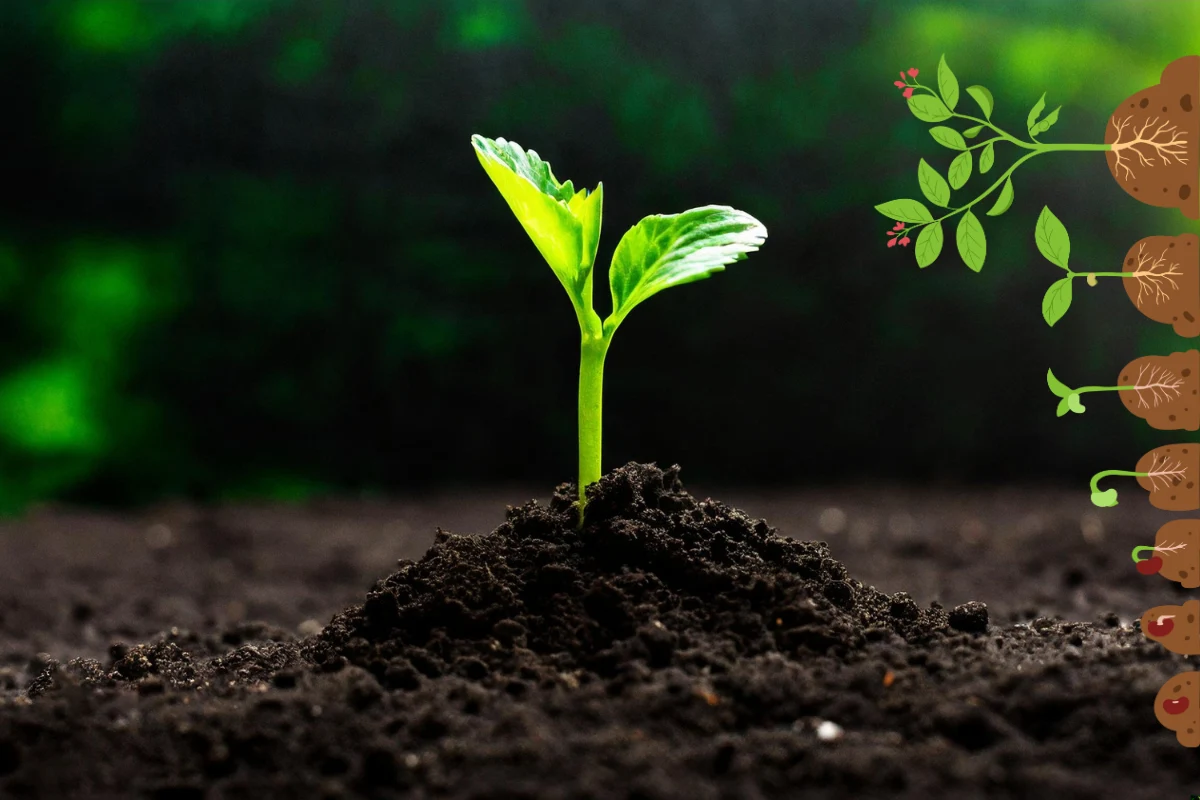
In what follows, I'll try my best to outline the entire journey, from stagnation to full recovery. Take notes!
Main ingredients: What does a plant need for photosynthesis?
Let me put it in a way that's easy to picture! Imagine your plant is a top chef and its leaves are the kitchen. To make a delicious meal, it needs four ingredients. If even one is missing, the whole process is disrupted. The meal can still be made, but it won't be anywhere near what it was supposed to be.
Four main ingredients:
- Light – the starter of everything. It gives the plant energy, just as electricity powers machines. If there isn't enough light, the plant has no fuel for growth. That's why the position where you keep the plant is of crucial importance.
- Water – A key part of the food-making process. When a root absorbs water, it moves through the plant to the leaves where it takes part in a chemical reaction that creates energy for growth. It is important not to overdo the amount of water here, as too much water can lead to root rot. It goes without saying that the pot should have drainage holes to prevent excess water from remaining in the soil.
- Carbon dioxide – a component the plant takes from the air through tiny openings on its leaves. It is essential for creating glucose, the plant's basic food, together with water and light. Therefore, plants will definitely grow more slowly in enclosed and smoky spaces.
- Chlorophyll – the green pigment in a plant, which captures light and converts it into energy. The greener the plant, the more chlorophyll it has ready to do its job. If the leaves are fading or turning yellow, it means the process is not working as it should.
By definition, photosynthesis It is the process by which a plant, with the help of its leaves, collects light energy, then uses it in the leaves themselves to combine water and carbon dioxide from the air, creating food for growth. The result is a healthy plant.
Do plants grow at night?
Of course, now that we have explained what photosynthesis is, we wonder what happens to our plants when darkness falls and we turn off the lights; do they still grow? The short answer is yes. Photosynthesis has two phases, a dark phase and a light phase. During the light phase, by day, the plant absorbs solar energy to the fullest in order to distribute it where it is needed most. That is why we often notice that a new leaf has appeared in the morning. The plant has been collecting energy during the day, which is then processed during the night (the dark phase).
How can you tell that photosynthesis isn't working properly?
Plants don't speak, but they certainly show us through their appearance when their internal system isn't functioning properly. The most obvious sign that photosynthesis is slowed or blocked is long-term stagnation. If it's spring and your houseplant isn't producing any new leaves, it's a clear sign that the plant doesn't have enough energy, or sugar, which it should be producing itself.
Besides a lack of growth, also pay attention to the size and shape of its leaves. When the photosynthesis process isn't working properly, the plant is forced to conserve resources. Because of this, new leaves will be significantly smaller than usual.
Also, the plant will begin to change its shape and colour. Pale, yellowish, dull leaves and long, thin stems will start to stretch unnaturally towards the nearest window; this is a clear sign. Your plant is trying to reach more light to restart its energy production.
What does all this mean for your houseplants?
Now I want to help you put the above knowledge into practice so that your houseplants look as though they've come straight out of the jungle. Simple rules for maintaining plant hygiene will help you support the photosynthesis process.
- Dusting the leaves – dust, figuratively speaking, acts like a lowered blind. Light cannot reach the green part of the leaf, the plant cannot absorb energy for growth and begins to starve. To avoid this, I advise regular leaf hygiene.
- Avoid yellowing in plants – if you put a plant in a dark corner of the hallway, it loses its fundamental source of energy – light. To survive in such conditions, the plant slows down all processes and cuts off the flow of energy to its older leaves, which eventually drop off. That's definitely not the aim!
- Good substrate is the key – You need a good substrate because it's literally a process where the root lives and works. If the soil is heavy and compacted, after watering it turns into mud, retains too much water and the root doesn't get any air – that's when it weakens and can rot.
On the other hand, if it's too poor and doesn't retain moisture, the water will simply pass through the soil and the plant will have nothing to absorb. This is where a quality growing medium comes in – it retains just the right amount of water, while allowing excess to drain away and air to reach the roots.
The most common myths about photosynthesis (and why they are not true)
The internet offers a wealth of advice on plant care, but when you understand the basics of photosynthesis, it's easier to separate fact from fiction. Here are 3 myths.
Plants only grow when you water them.
Scientific fact: Water provides cell rigidity and is just one of the raw materials for photosynthesis. It does not directly drive growth. Plants grow thanks to glucose, which is produced by combining light and carbon dioxide. Water is an essential element in plant growth, but it is not the only one, nor the most important.
The plant can live in the dark.
Scientific fact: Light is not just a visual stimulus for the plant; it is the source of energy that drives the other three elements to provide the plant with food. A plant in the dark does not live, but slowly starves and survives by consuming its previously stored reserves. Even shade-tolerant plants require a certain level of light for photosynthesis.
Fertiliser from the bottle is the main food for plants.
Scientific fact: This is probably the biggest misconception in the world of houseplants. Plants are autotrophic organisms, which means they exclusively produce their own food through photosynthesis. The fertiliser you add to the water isn't food, but a set of minerals that actually act as vitamins and building blocks. For example, the nitrogen from the fertiliser helps the plant create more chlorophyll, but if there's no light to activate that chlorophyll, the plant will starve regardless of how much nitrogen it has received. Real food comes from the window, not the bottle.
Conclusion:
Now that you know how plants eat and grow, it's clear that there's no magic potion from the agricultural chemist's that will create the perfect ficus or philodendron overnight. It all comes down to biology and the very basics of everything.
Once you've provided the plant with enough light and clean, dust-free leaves, there's only one more step left, but the most important one – a healthy root system to back it all up.
That is why houseplants require a coarse, airy substrate. With this very goal in mind, we have developed special substrates that provide perfect drainage, airflow and stable moisture.
Remember: No light + water + substrate = no photosynthesis = no new leaves.
If you want your plants to have a long life, I advise you to keep following the blog. In upcoming posts, we will cover in more detail their growth, care, repotting, and all the little tricks that make a big difference in the world of houseplants.
See you soon!


Price range: 1.140,00 RSD through 3.534,00 RSD
Select options
This product has multiple variants. The options may be chosen on the product page
Price range: 110,40 RSD through 1.152,00 RSD
Select options
This product has multiple variants. The options may be chosen on the product page
Price range: 684,00 RSD through 2.622,00 RSD
Select options
This product has multiple variants. The options may be chosen on the product page


Price range: 3.351,00 RSD through 3.408,00 RSD
Select options
This product has multiple variants. The options may be chosen on the product page

