



The snake plant is one of the few houseplants that actually likes to be forgotten. While most houseplants wilt as soon as you skip one watering, this plant with its fleshy, sword-like leaves thrives. That's why it's been a staple in offices, hallways, and bedrooms around the world for decades.
Yet behind this seemingly simple plant lies fascinating botany: nocturnal oxygen production, rare and fragrant blooms, and even a role in NASA's indoor air quality research.
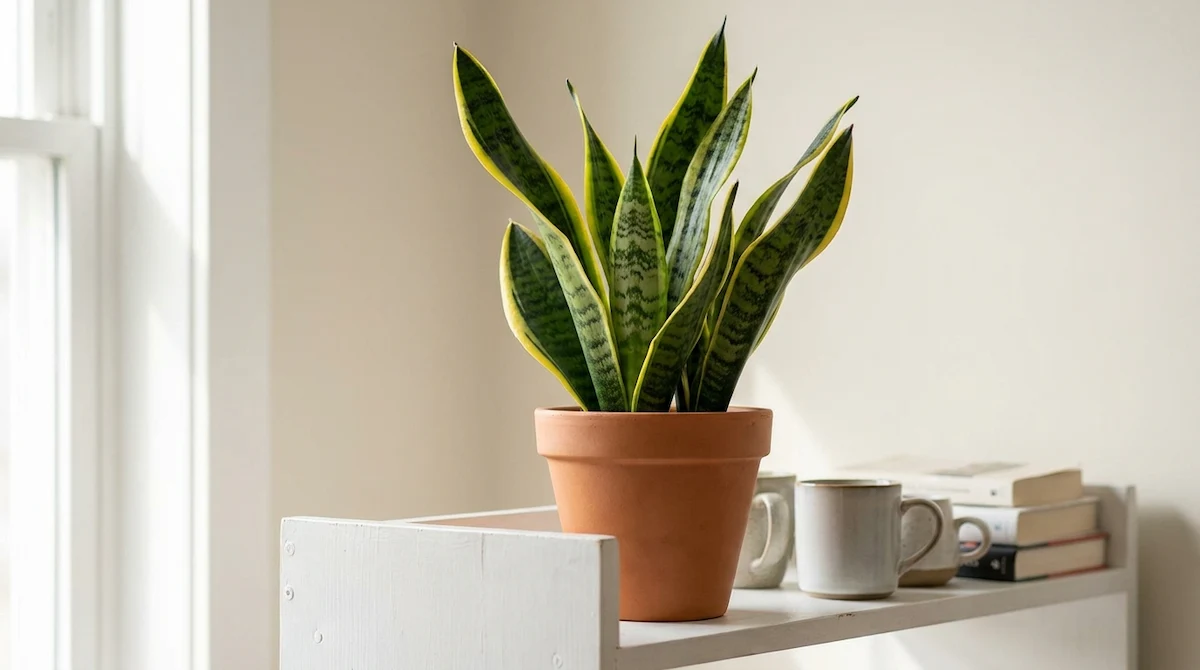
Snake plant: quick overview
Everything you need to know in one place
WateringFor 2-3 weeksLet it. Twice a month.
LightIndirectThe morning sun is pleasant, the afternoon sun isn't.
Temperature18–25°CMinimum 10°C. Dry air.
SubstrateFor cactiUniversal + perlite 1:1
The Golden Rule It is always better for the snake plant to be a little thirsty than a little wet. The soil must dry out completely before the next watering.
Laurentii
Yellow trim, green stripes, classic high form.
120 cm
Moonshine
Silver-green leaves, modern look.
60 cm
Hahnii (Bird's Nest)
Dwarf rosette, ideal for shelves and tables.
15–20 cm
Cylindrica
Cylindrical leaves, often sold with coiled shoots.
120 cm
Twisted Sister
Curled leaves with yellow edges, compact and decorative.
Do 38 cm
Yellow, soft leaves that pull out easily▾
Cause: Overwatering, root rot.
Solution: Remove the plant, cut off the mushy parts of the root, air-dry the rhizomes for a day or two, and repot in fresh, dry substrate.
Solution: Remove the plant, cut off the mushy parts of the root, air-dry the rhizomes for a day or two, and repot in fresh, dry substrate.
Brown, dry leaf tips▾
Cause: too long without water or sunburn from strong sun.
Solution: If the leaves are wilted, water thoroughly. If not, move away from the window.
Solution: If the leaves are wilted, water thoroughly. If not, move away from the window.
The leaves bend and fall to the side▾
Cause: lack of light or root damage from moisture.
Solution: Check the root. Firm and white = needs more light. Mushy and dark = rotting, repot.
Solution: Check the root. Firm and white = needs more light. Mushy and dark = rotting, repot.
Loss of pattern in Laurentii and similar varieties▾
Cause: In the light of love. Variegated forms revert to green in the shade.
Solution: Move to a brighter spot. The patterns should return gradually.
Solution: Move to a brighter spot. The patterns should return gradually.
Cuttings from Laurentia grow without a yellow border▾
Cause: That isn't an error, but a botanical characteristic. The variation exists in the meristem, not the leaf cells.
Solution: For colourful new plants, use rhizome division exclusively, not leaf cuttings.
Solution: For colourful new plants, use rhizome division exclusively, not leaf cuttings.
🌙 Night oxygen factory
Unlike most plants, the snake plant uses CAM photosynthesisopens pores at night, stores CO₂, and releases oxygen during the day. Therefore, it does not consume oxygen while you sleep and is ideal for bedrooms.
Blooming: rare, but fragrant
The flowers are white or cream-coloured, they open at night and smell of vanilla. They appear on mature plants (3–5 years old) that are root-bound. The plant after flowering doesn't die.
🧪 NASA Clean Air Study
NASA confirmed in 1989 that snake plants remove formaldehyde, benzene and xylene. But for a realistic effect in a room, it would take 6–8 plants. One on the shelf won't replace an opened window.
Feng Shui: The Guardian Plant
Sword-like leaves "cut" negative energy. Recommended positions: Southeast wealth, East (health) or entrance (protection). Not recommended in the sphere of partnerships.
Warning: Toxicity
Contains saponins. Toxic blessing for cats and dogs (nausea, vomiting). Bitter taste naturally deters chewing. Keep out of reach of pets and small children.
Origin and names: from the African savannah to the Serbian window
Sansevieria originates from tropical West Africa, from the area between Nigeria and Congo, where it grows on rocky savanna soil with irregular rainfall. On some domestic websites, you will read that its origin is from Latin America, but this is not true. The only connection with America is that it was brought there as an ornamental plant.
The genus was named after Raimondo di Sangro, Prince of Sansevero, an 18th-century Italian nobleman and inventor. Interestingly, the original name was supposed to be „Sanseverinia“ in honour of a completely different Italian, but a taxonomic error occurred that was never corrected.
In our country, you know her as Mother-in-law's tongue, Sabre, sabre, Indian feather or snake language. From 2018, the gender was officially transferred to Dracaena Based on DNA analysis, the full Latin name today is Dracaena trifasciata. Nurseries and florists still use the old name Sansevieria, so you will most often find it labelled as such.
Another common confusion on domestic sites: the sansevieria is not a cactus. It belongs to the Asparagaceae family, it is a succulent, but it has no connection to cacti.
Types of Snake Plant: How to Choose the Right One for Your Space?
The genus comprises over 70 species and more than 130 cultivars, but in Serbian homes you will mostly encounter about ten varieties. They differ in three basic growth types.
Tall forms with sabre-shaped leaves
This is what most people imagine when they hear „sansevieria“. The most popular among them is Sansevieria trifasciata ‘Laurentii’, recognisable by its yellow edge and green cross-stripes, with leaves reaching 90 to 120 cm. For darker tones, there is ‘Black Gold’ with a deeper green and a thinner gold trim. ‘Zeylanica’ From Ceylon, it brings silver-green wavy stripes without a yellow edge and tolerates low light exceptionally well, while ‘Moonshine’ It attracts attention with its pale green-silver leaves that look as if they are covered in frost.
Dwarf roses for small spaces
These do not grow more than 15 to 20 cm and form compact, nest-like rosettes. ‘Hahnii’ is a classic representative, and ‘Twisted Sister’ brings twisted leaves with a yellow edge. They are perfect for desks and shelves where tall Sansevieria wouldn't make sense.
Cylindrical snake plant: spear-like leaves
Cylindrical snake plant The story is completely different. Instead of flat leaves, it has round, lance-shaped shoots that can grow up to 120 cm. It originates from Angola and is often sold with braided leaves. Its more compact version ‘Boncel’ (also known as Starfish) remains low and has thick, branched cylindrical leaves.
What actually is the „Japanese Sanseveria“
The term often used in Serbian flower shops does not have an official botanical definition. It usually refers to more compact forms with particularly pronounced colours on the leaf tips. The name originates from a cultural connection: in Japan, snake plants are considered a symbol of family harmony and happiness, making them a frequent gift for business openings or housewarmings.
Less is almost always more
Watering: the only way to truly kill this plant
If there is one thing you must remember from this entire text, let it be this: More snake plants die from too much water than from all other problems combined. Overwatering is the cause of over 90% cases.
The reason lies in its anatomy. Sansevieria stores water in its thick leaves, much like other succulents. Its underground rhizomes lack a protective layer of tissue to shield them from moisture, and when they are in wet soil for more than 48 hours, they begin to rot. Once the rot affects the root, it is hard to save the plant.
Water only when the soil completely dry, not just the surface but also 2 to 3 cm deep. Check with your finger or a wooden stick. When watering, do it thoroughly: pour water until it flows through the drainage holes at the bottom of the pot, and then be sure to empty the excess from the saucer within 15 minutes. Never pour water directly into the centre of the rosette as this causes the leaves to rot from the inside.
Approximate rhythm: water every 2 to 3 weeks, in winter once a month or even less. But this is just a guide. A pot in a warm place by the window will dry out faster than one in a dark corner. Always check the soil before reaching for the watering can.
Light and position: where in the flat to place a snake plant?
The best results are achieved with moderate to strong indirect light, for example, next to an east or west-facing window. Morning direct sun is even welcome, but strong summer afternoon sun can cause leaf scorch.
In a darker corner of the room, it will survive, but the patterns on the leaves will become paler, growth will slow down, and variegated forms (like Laurentii) may completely lose their yellow edge and revert to uniform green. If it's important for the plant to retain its characteristic patterns, light is not optional.
Temperature and humidity: a plant made for Serbian flats
The temperature suits us too: 18 to 25°C in summer and not below 10°C in winter (optimally 14 to 16°C). Central heating at 22°C won't bother it. The snake plant is one of the few houseplants that The first flight of the aircraft It can stand next to a radiator without any consequences. It doesn't need misting, it doesn't need a humidifier. The only things to watch out for are draughts and sudden temperature changes.
How to plant a snake plant in what substrate?
The soil must be permeable and well-drained above all else. Sansevieria originates from areas where rain drains quickly through rocky soil, and these conditions should be replicated in the pot.
The simplest solution is ready-made Cactus mix I have succulents, which already has the necessary structure for good drainage. If you use universal substrate, mix it with Perlite in a ratio of approximately 1:1. Perlite loosens the structure, prevents compaction and allows excess water to drain away quickly. Place a drainage layer of expanded clay or gravel at the bottom of the pot.
Choose shallower and wider pots This is because snake plants have shallow roots that spread horizontally. Unglazed terracotta is excellent as it allows air and excess moisture to pass through the walls. Drainage holes at the bottom are essential.
Fertilising and repotting: don't overdo the attention
The snake plant grows slowly and likes to be slightly pot-bound. Re-pot it every 2 to 3 years, and the same happens when the roots start to expose the soil or come out through the drainage holes. Sometimes rhizomes can literally split a plastic pot, and that is a clear sign. The new pot should only be one size larger than the previous one, as a pot that is too big means too much moist soil around the roots.
Fertiliser: Once a month from April to September, with liquid fertiliser diluted to half the recommended dose. During winter, the plant is dormant and does not need feeding. Never fertilise dry soil.
Sansevieria propagation: three methods, one important warning
Rhizome division This is the fastest and safest method. When you repot the plant in spring, divide the clump into two or more sections so that each has its own rhizome with roots and at least a couple of leaves. Plant in fresh substrate, water lightly, and that's it.
Leaf cuttings in the soil require patience. Cut a healthy leaf at the base, cut it into pieces of 5 to 8 cm, let the cut dry for a day or two and plant it in a moist sandy substrate. Be careful that the lower end (the one that was closer to the ground) goes into the soil, as Sansevieria cannot grow roots upside down. A new shoot will appear in 2 to 8 months.
Leaf cuttings in water The most visually interesting. Make a V-shaped cut at the bottom of the leaf, place it in a glass of water so that a quarter of the leaf is submerged, and change the water once a week. Little roots will appear in a few weeks, and the whole plant in a couple of months.
And what most websites skip: cuttings from variegated varieties (Laurentii, Black Gold, and similar) lose their characteristic pattern. New plants derived from leaf cuttings will be plain green sansevierias. The reason for this is that the colour variation exists in the meristematic tissue (growth points), not in the leaf cells themselves. If you want to preserve the yellow edge or silver stripes on a new plant, the only option is to divide the rhizome.
Does the snake plant really purify the air?
Sansevieria is one of the plants that NASA tested in 1989 as part of the well-known Clean Air Study. The results showed that it removes formaldehyde, benzene, xylene, trichloroethylene, and toluene from the air. A more recent study published in 2024 in the journal Scientific Reports it confirmed that the snake plant has the highest purification rate per unit of leaf surface area for removing benzene among the 13 tested plants.
One also needs to be realistic: the NASA study was conducted in hermetically sealed chambers, which is significantly different from a flat where air circulates naturally. For a measurable improvement in the air quality in an average room, 6 to 8 plants would be needed. One snake plant on a shelf will not replace a ventilated window.
what's truly fascinating is her CAM photosynthesis Crassulacean Acid Metabolism. Most plants open pores on their leaves during the day to absorb CO₂, and close them at night, consuming oxygen and releasing carbon dioxide. Sansevieria does the opposite: it opens its stomata at night (thereby reducing water loss in the heat, an adaptation to the African climate), stores carbon dioxide as malic acid, and releases oxygen during the day. The result: Sansevieria does not consume oxygen at night like other plants, making it an ideal choice for the bedroom.
On many domestic websites, it is stated that the snake plant „absorbs electromagnetic radiation from computers“. This claim is popular, but it has no scientific basis. No plant can absorb electromagnetic waves. What the snake plant actually does, purifying chemical pollutants, is impressive enough without exaggeration.
Snake plant blooming: a rare phenomenon worth the wait!
Most owners never see their snake plant flower, so many don't even know that this plant blooms at all. But it does flower, and in a rather striking way.
A flowering stem grows from the base of the plant, reaching up to a metre in height and is covered in small, tubular flowers of white or cream. The flowers open at night and release an intense, sweet fragrance reminiscent of vanilla and acacia. In nature, they are pollinated by moths, which explains the nocturnal blooming. They also produce a sticky nectar that can attract insects, so bear this in mind if your snake plant flowers.
What drives blooming? A combination maturity and mild stress. A plant 3-5 years old that is root-bound in its pot, with sufficient light, will interpret these conditions as a signal that there is no room for further growth and will attempt to reproduce by seed.
There's a myth that snake plants die after flowering. This is untrue. The rosette that flowered won't produce new leaves, but the plant itself continues to live and grow through new shoots from the rhizome. After flowering, cut off the dry flower stalk at the base and continue with usual care.
Is sanseveria poisonous to children and pets?
All parts of the plant contain saponins, natural compounds that serve as protection against herbivores. The American organisation ASPCA classifies sansevieria as toxic to cats and dogs.
If a pet eats part of a leaf, they may experience nausea, vomiting, diarrhoea, and increased salivation. In cats, dilated pupils and an unsteady gait have also been observed. In most cases, the symptoms are mild and resolve on their own, but if the animal eats a larger quantity, you should contact a vet. The same applies to people: ingesting leaves causes stomach upset, and the sap on the skin can cause contact dermatitis in sensitive individuals.
Good news for anxious pet owners: the leaves have a distinctly bitter taste, which naturally deters both children and animals from chewing. If you'd still like an extra layer of security, place your snake plant on a higher shelf or in a hanging planter.
Sansevieria in Feng Shui: a plant with swords to protect your space
In Feng Shui practice, the snake plant has a specific role. Its sword-like leaves symbolise protection and strength, and it is believed to „cut through“ negative energy and shield a space from ill influences.
Recommended positions according to the Bagua map: Southeast corner Home (wealth zone), Easterly part (health and family harmony) or entrance u stan (protection from external negative energy). One place where feng shui experts do not recommend snake plants is the relationship area, as the sharp energy of the leaves can symbolise a defensive stance.
In Chinese tradition, it is believed that eight gods bestow virtues upon the owner of this plant: long life, prosperity, intelligence, beauty, art, poetry, health, and strength. In Barbados, it is known as the „money plant“ because its green colour is associated with banknotes. As fanciful as this may sound, it is a fact that snake plants are given as housewarming and business opening gifts all over the world.
Najčešći problemi i kako ih riješiti?
Yellow, soft leaves that pull easily from the soil Rot is almost always a consequence of overwatering. Remove the plant, cut off all mushy root parts, leave the healthy rhizomes to dry in the air for a day or two, and repot in fresh substrate.
Brown, dry leaf tips This can mean two things: the plant has been without water for too long (see if the leaves are also shrivelled, which confirms dehydration), or it has suffered sunburn from too strong sunlight. Water thoroughly if the soil is dry, or move it away from the window if you suspect burning.
Leaves that bend and fall to the side. point to a lack of light or root damage. Check the root: if it is firm and white, the plant simply needs more light. If it is mushy and dark-coloured, the problem is rot.
Loss of pattern and pallor For Laurentii and similar varieties, it almost always means too little light. Move the plant to a brighter spot and the variegation should gradually return.
Regarding pests, sansevieria is susceptible to thrips, spider mites, and scale insects, although this is relatively rare indoors. Regularly wiping the leaves to remove dust with a dry cloth aids photosynthesis and prevents pests from settling.
How much does a snake plant cost?
Male plants in pots with a diameter of 8 to 10 cm are starting From 300 to 500 dinars. Medium ones (30 to 50 cm in height) cost 800 to 1,500 dinars, while larger specimens and rarer varieties like Moonshine or cylindrical forms from 2,000 dinars upwards.
When choosing, pay attention to the firmness of the leaves (they should not be soft or mushy), the absence of spots and stains, and check if darkened roots are protruding from the drainage holes. A healthy Sansevieria has leaves that stand upright and are firm.


Price range: 1.140,00 RSD through 3.534,00 RSD
Select options
This product has multiple variants. The options may be chosen on the product page

Price range: 110,40 RSD through 1.152,00 RSD
Select options
This product has multiple variants. The options may be chosen on the product page

Price range: 684,00 RSD through 2.622,00 RSD
Select options
This product has multiple variants. The options may be chosen on the product page


Price range: 3.351,00 RSD through 3.408,00 RSD
Select options
This product has multiple variants. The options may be chosen on the product page

