



When you ask horticultural experts what a drainage layer is, they will tell you that it is a prerequisite for a plant's roots to live and develop unhindered. It, along with other factors, determines whether the roots will rot from excess water, get enough air, and be properly nourished by the growing medium.
Stay with us until the end of the article to learn all about drainage in pots, its importance, the types of drainage layers and materials used, practical procedures, and specific recommendations for different groups of plants.
Why is a drainage layer added to pots?
A drainage layer is a layer of material (gravel, sand, cinders or broken pottery, expanded clay, vermiculite, perlite and other natural materials) which is placed at the bottom of the pot and planting hole to allow excess water to drain away, to supply oxygen to the roots for unimpeded branching, and to reduce the risk of root rot.
To understand why a drainage layer at the bottom of the pot is important for plants, it is helpful to think of the plant as a capillary system, rather than as a closed unit.
You should know the following:
- The soil in the pot behaves as a capillary mass; water is held in the pores.
- At the point of transition between the fine (substrate) and coarse (drainage layer) material, a permanent layer of saturated water often forms, which does not easily move into the coarser layer due to a difference in capillary action.
Therefore, the main function of proper drainage is to:
- Enables an even drainage of excess water when watering and reduces water retention in the substrate (if the substrate is properly formulated).
- Prevent soil from clogging the drainage hole at the bottom of the pot and allow for free flow.
- In some cases, to mechanically stabilise the substrate and prevent its too rapid leaching.
The most common types of drainage materials in pots and the recommended amount
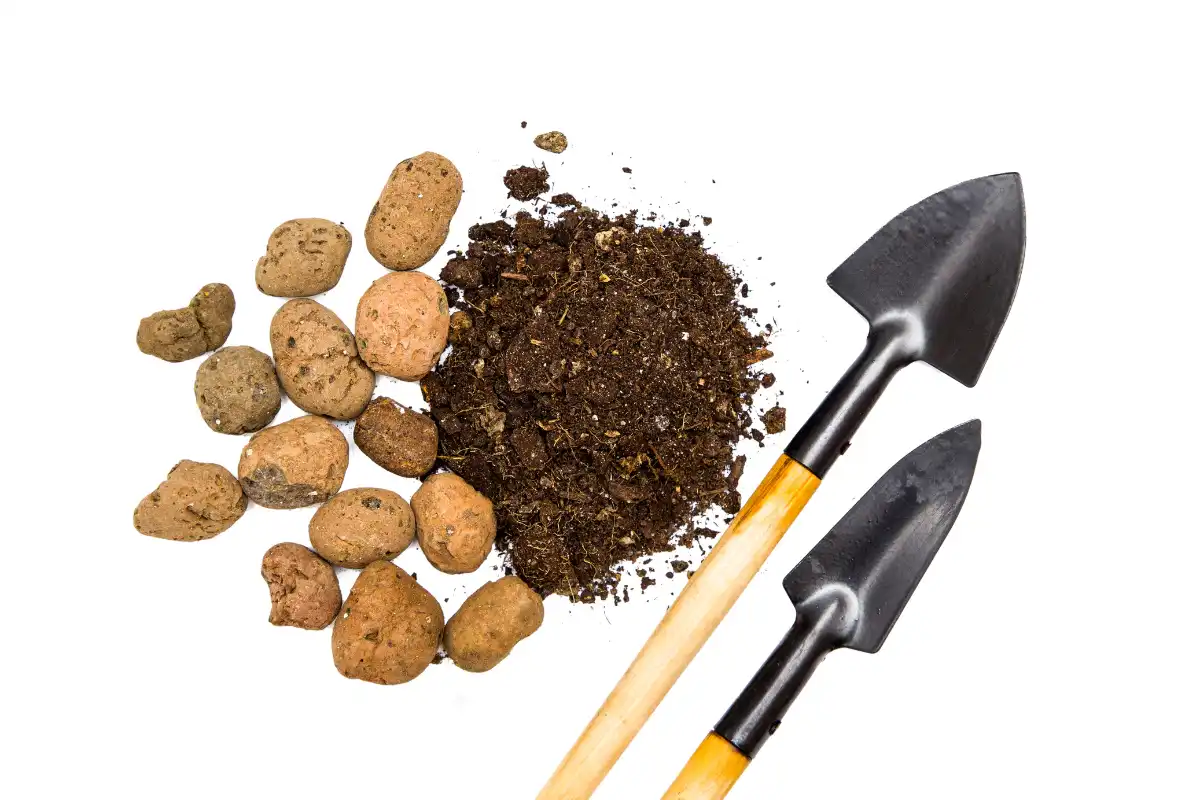
Gravel or small stones
This drainage layer is the most common, it is cheap, available, and prevents the substrate from being washed out through the hole.
Its drawbacks are that it creates a pronounced blockage in the pot's drainage if used in a large thickness, and it does not improve the internal porosity of the substrate.
A layer of 1-2 cm is practised, which can be sufficient to protect the hole, while thicker layers are often not beneficial.
Pieces of terracotta or ceramic
The advantage of this drainage layer is that it consists of very stable pieces, which withstand mechanical pressure well and prevent washout.
The disadvantage is that the material can retain moisture in the cracks if a thick layer is applied.
Used in a 1–2 cm layer to protect openings and ensure water flow.
Vermiculite
Vermiculite is a natural mineral that expands when heated. It has good surface moisture absorption, is often used in horticulture and construction, absorbs and retains water and nutrients well from the substrate, and has a neutral pH.
Vermiculite is not considered a classic drainage material but rather an additive to the substrate. Its primary role is to retain moisture and nutrients, which is why it is used as Substrate additive, not as a lower drainage layer. If placed in larger quantities at the bottom of the pot, it can contribute to moisture retention and reduce aeration.
In practice, it is used both as a layer and as a component in mixtures (e.g. 10-20 % volumes of substrate).
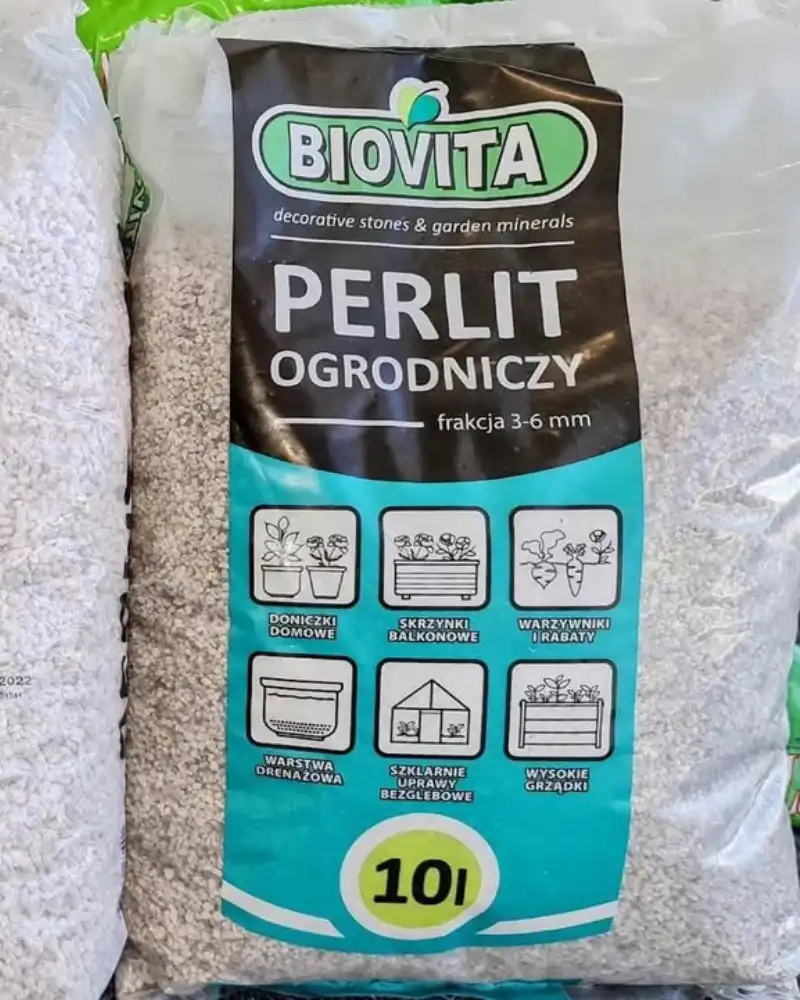
Perlite
Perlite It is a lightweight material of volcanic origin, white in colour, sterile, chemically inert, and neutral pH. It provides breathability and does not retain moisture at the roots, but instead allows for rapid drainage.
Perlite is usually mixed into the growing medium to improve porosity, and it is not advisable to use it on its own as a drainage layer. If laid as a layer, very fine perlite can become saturated and retain moisture, so it is not ideal as a standalone base layer.
Expanded clay
Expanded clay (often known as LECA – Lightweight Expanded Clay Aggregate) is baked clay that expands at high temperatures (baked at 1100-1200°C) into lightweight, small pellets. It is used in horticulture, construction and hydroponics due to its stability, porosity and neutrality.
What grows in the pot:
- Improves drainage – water passes easily between the beads
- Increases aeration – the root has more oxygen
- Does not retain excess water (only a thin film of moisture on the surface)
- Stabilises the substrate and reduces soil compaction
- It is chemically inert – it does not change the pH and does not „feed“ mould on the soil.
It is used as a bottom layer (1-2 cm at the bottom of the pot), as an additive to the substrate (10-30 % volume of the mix) or as a decorative surface layer as it reduces evaporation, prevents the appearance of mould on the surface of the ground It is also an aesthetically neat solution.
Which drainage layer is used for which plants?
The choice of drainage layer in the pot depends on the type of plant and its moisture requirements, so the following recommendations are applied in practice:
- Succulents and cacti – a thin drainage layer of expanded clay or coarse gravel (1-2 cm)
- Houseplants (Monstera, Ficus, Philodendron) – expanded clay or ceramic pieces (1-2 cm)
- Flowering plants and plants with moderate water needs – a thin layer of gravel, broken pottery or expanded clay
- Plants that like constant moisture (ferns, certain houseplants) – minimal protective drainage layer or no distinct drainage layer
- Herbs and vegetable plants in pots – expanded clay or gravel (1-2 cm)
- Plants in large or outdoor pots – expanded clay or coarse gravel (1-2 cm)
Regardless of the plant group, it is crucial to understand that the drainage layer is not a substitute for quality substrate, but a supplementary measure which, when applied correctly, contributes to root health and the long-term development of the plant.
Price range: 1.140,00 RSD through 3.534,00 RSD
Select options
This product has multiple variants. The options may be chosen on the product page
Price range: 105,00 RSD through 1.056,00 RSD
Select options
This product has multiple variants. The options may be chosen on the product page
Price range: 684,00 RSD through 2.622,00 RSD
Select options
This product has multiple variants. The options may be chosen on the product page
Price range: 3.351,00 RSD through 3.408,00 RSD
Select options
This product has multiple variants. The options may be chosen on the product page

