


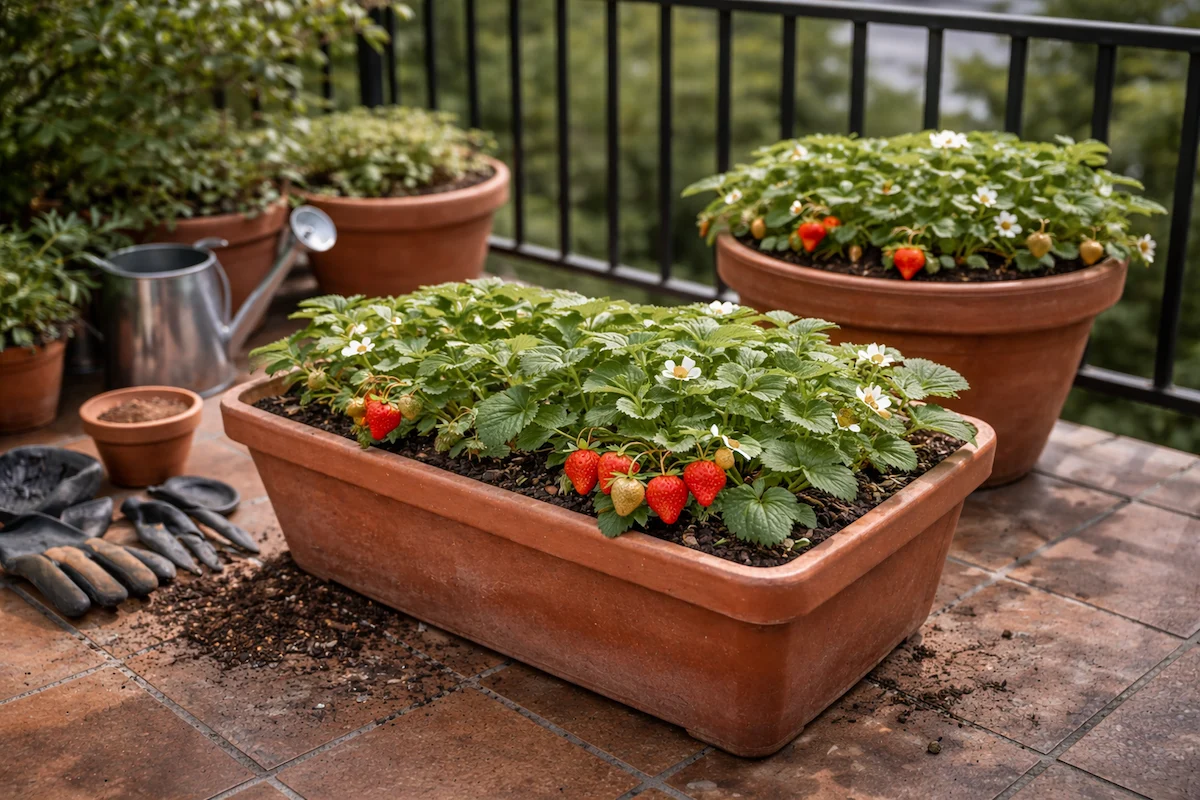
Imagine stepping out onto your balcony, picking a few sun-warmed, red strawberries, and eating them right there. It sounds like a luxury, but it's actually attainable for anyone with a pot, a bit of soil, and a sunny balcony.
Strawberries are one of the few fruit species that do very well in pots. Their roots are shallow, they don't take up much space, and if you choose the right variety, they will produce fruit from May right up until December. In addition, strawberries in pots are less exposed to diseases and pests than those in the garden, the fruits don't touch the soil so they are cleaner, and you have complete control over the conditions in which the plant grows.
In the following text, we'll go through everything you need to get started, from choosing the variety and pot, through the substrate and planting, to watering, feeding, and preparing for winter.
Koje sorte jagoda su najbolje za gajenje u saksiji?
When choosing a variety for your balcony, the most important thing to know is the difference between single-cropping and ever-bearing (continuously fruiting) strawberries.
June-bearing varieties produce one abundant crop in the spring and then stop. This isn't ideal for balcony growing, as you'll only have strawberries for a few weeks of the year, and the pot will sit empty for the rest of the season. Everbearing varieties, on the other hand, fruit multiple times from late spring to autumn, and even into early winter if the pot is brought into a warm room. They are a vastly better choice for a balcony.
Of the everbearing varieties that have proven reliable in pots, Albion stands out for its large and aromatic fruit, Toscana, which, besides delicious strawberries, also has beautiful pink flowers and thus serves as an ornamental plant, and older but tried-and-tested varieties like Gem and Obari Beauty. All four tolerate the limited space of pots and yield a good harvest with regular care.
If you've only just started with balcony gardening, begin with three to five seedlings. That's enough to gain experience and have a regular small harvest without too much work.
What kind of pot is needed for strawberries?
Strawberries do not develop a deep root system, but they do need space for the root system to spread unimpeded. The minimum is a pot 20 cm deep and 25 to 30 cm wide per plant. If you plan to plant multiple plants together, a planter 60 to 80 cm long can accommodate three to four seedlings with adequate spacing.
The material of the plant pot is a matter of priority. Plastic pots are lighter, cheaper, and retain moisture for longer, meaning less frequent watering. Terracotta and ceramic pots allow better air circulation to the roots and look nicer, but they dry out faster and are heavier, which can be a problem on a balcony. Both materials do the job, but what is non-negotiable are the drainage holes at the bottom. Without them, water collects, the roots rot, and the plant dies. If you like a pot that doesn't have holes, simply drill three to four holes about one centimetre in diameter in the bottom.
For those who want to make the most of vertical space, hanging pots and strawberry towers are an excellent solution. Strawberries naturally produce runners that trail beautifully over the edge of the pot, making them visually appealing as well.
The ideal substrate for strawberries in a pot is a well-draining, fertile mix. A good combination would be: * **Peat or coir:** Provides good water retention and aeration. * **Compost or well-rotted manure:** Adds nutrients and improves soil structure. * **Perlite or grit:** Enhances drainage to prevent waterlogging, which strawberries dislike. A ratio of roughly 2 parts peat/coir to 1 part compost and 1 part perlite/grit usually works well. You can also buy specialised strawberry potting mixes.
This is the part that makes the difference between an average and a truly good harvest. Garden or field soil is not an option for potted plants because it is too heavy, compacts quickly, drains poorly, and doesn't have enough nutrients for the limited space of a pot.
Strawberries need quality substrate which is loose, retains moisture well but not excess water, and has adequate pH value Between 5.5 and 6.5. In this range, strawberries best absorb nutrients from the soil and produce the sweetest fruits.
Substrate Maki Plus It is an excellent base for strawberries in pots. It is made from a mixture of light and black peat with a pH of 5.5 to 6.0, enriched with slow-release fertilisers, and has a uniform structure that provides exactly what strawberries need: good moisture retention combined with breathability.
To further customise it with strawberries, mix it with Perlite from Agro In a ratio of approximately 4:1, meaning four parts of substrate to one part of perlite. Perlite opens up the soil structure, allows air to reach the roots, and prevents the substrate from compacting during the season, which is a common issue in container gardening.
If you want a completely organic feeding option, pure organic earthworm casting From our offering, you can mix it into the substrate in a small amount, approximately one handful for each pot. Mica slowly releases nutrients and improves the biological activity in the substrate, which strawberries benefit from throughout the entire season.
Here's how to properly plant strawberries in a pot, step by step: 1. **Choose the right pot:** Select a pot that's at least 15-20 cm deep and wide, with drainage holes at the bottom. Terracotta or fabric pots are excellent choices as they allow for good air circulation. 2. **Prepare the soil:** Use a well-draining potting mix. A good blend would be 1 part compost, 1 part peat or coir, and 1 part perlite or coarse sand. This ensures good aeration and drainage, preventing waterlogging. 3. **Select your strawberry plants:** You can use bare-root strawberry plants or small, established plants from a nursery. For bare-root plants, inspect the roots and trim any damaged ones. 4. **Planting the strawberry:** * **For bare-root plants:** Soak the roots in water for about 30 minutes before planting. Create a mound of soil in the centre of the pot. Place the plant on top of the mound, spreading the roots out over it. Ensure the crown (the thick part where the leaves emerge) is at soil level. Do not bury the crown, as this can lead to rot. * **For potted plants:** Gently remove the plant from its nursery pot. If the roots are tightly bound (root-bound), gently loosen them. Dig a hole in the prepared soil in your new pot large enough to accommodate the root ball. Place the plant in the hole, again making sure the crown is at soil level. 5. **Firm the soil:** Gently firm the soil around the base of the plant to remove any air pockets and ensure good root contact with the soil. 6. **Water thoroughly:** Water the newly planted strawberry well until water drains from the bottom of the pot. This helps settle the soil and reduces transplant shock. 7. **Positioning:** Place the pot in a location that receives at least 6-8 hours of direct sunlight per day. Strawberries need plenty of sun to produce fruit. 8. **Mulching (optional but recommended):** You can add a thin layer of mulch, such as straw or wood chips, around the base of the plant. This helps retain moisture, suppress weeds, and keep the fruit clean. **Ongoing Care:** * **Watering:** Water regularly, keeping the soil consistently moist but not waterlogged. Water more frequently during hot, dry weather. Water at the base of the plant to avoid wetting the leaves and fruit, which can encourage disease. * **Feeding:** Feed your strawberry plants with a balanced liquid fertiliser every 2-4 weeks during the growing season, especially once you start seeing flowers and fruit. * **Pest and Disease Control:** Keep an eye out for common pests like slugs, snails, and aphids. Deal with them promptly. Ensure good air circulation to help prevent fungal diseases. * **Runner Management:** Strawberry plants will produce runners (stray stems that can root and form new plants). Unless you want to propagate more plants, it's best to snip these off to encourage the main plant to focus its energy on producing fruit. By following these steps, you should be able to enjoy delicious homegrown strawberries from your pots!
Before you even pour in the substrate, put on the bottom of the pot drainage layer two to three centimetres thick. This can be larger gravel, crushed pottery, or expanded clay. This layer prevents drainage holes from becoming blocked and ensures that excess water flows away smoothly.
On top of the drainage layer, fill with the prepared mixture of substrate and perlite to approximately two-thirds of the pot's height. Then, place the seedling, paying attention to a detail that beginners often overlook: the plant's heart, or the central part from which the leaves emerge, must be precisely at soil level. If you bury it too deep, the plant may rot. If it remains too high above the surface, the roots will dry out and the plant will weaken.
Arrange the carrot seedlings so they spread out in the pot, rather than being crammed into one clump. Then, top up with compost to the brim, press down gently with your hands, and water with a moderate amount of water, just enough for the soil to settle and adhere to the roots. The spacing between plants in the same pot should be at least 20 centimetres.
The best time to plant is early spring, as soon as the hard frosts have passed, or early autumn, September and early October, when the plant has enough time to establish itself before winter.
How often to water strawberries in a pot?
Potting soil dries out much faster than garden soil, especially on a balcony that catches sun and wind. During the summer, you will probably need to water every day, and on the hottest days, even twice a day, in the morning and evening. In spring and autumn, every other or third day is sufficient, depending on the temperature.
The simplest test is the finger in the soil. Push your index finger two centimetres into the substrate. If it's dry, water. If it's still moist, wait.
Use water at room temperature, ideally left to stand. Water directly onto the substrate, around the edge of the pot, and never onto leaves or fruit. Wet leaves and fruit are an invitation for grey mould and powdery mildew, which are two of the biggest enemies of strawberries. If the pot is standing on a saucer, be sure to pour away any excess water that collects after watering. Roots standing in stagnant water perish faster than those that are slightly drier.
Saving strawberries in pots, when and with what?
Unlike garden plants which have access to more soil and its reserves, strawberries in pots depend solely on what you give them. The substrate you initially put in contains fertiliser, but this gets used up within a month or two, after which feeding becomes essential.
Approximately two to three weeks after planting, start feeding with a liquid fertiliser for fruiting plants, once every two weeks during active growth. Choose fertilisers with a slightly higher potassium content than nitrogen, as potassium promotes flowering and fruit formation, while excessive nitrogen results in lots of leaves and few strawberries.
For those who prefer organic feeding, diluted earthworm castings in water, so-called worm tea, is an excellent option. Soak a handful of earthworm castings in a litre of water, leave it to stand for a day or two, strain it and use it to water your plants. Strawberries absolutely love it.
Cease feeding in late autumn when the plant enters its dormant period.
Protecting strawberries from diseases and pests on a balcony
One of the great advantages of growing strawberries on a balcony is that they are isolated from many problems that occur in the garden. However, they are not completely immune.
The most frequent guests are Herbal tea, small green or black insects that gather on the underside of leaves and stems. You'll notice them by sticky residue and curled leaves. If caught in time, it's usually enough to rinse them off with a strong jet of water or spray the plant with a solution of mild soap in water.
Grey mould appears as a grey, cobweb-like layer on the fruit, usually during damp periods or when watering the leaves. Prevention is key: good air circulation around the plant, watering only at the roots, and removing any damaged fruit as soon as you notice it.
Powdery mildew is recognised by a white, dusty coating on the leaves. Regularly remove affected leaves and ensure the plant has adequate light and ventilation.
As a general rule, you should inspect your plants regularly, at least every two to three days, checking the top and underside of the leaves. The sooner you spot a problem, the easier it will be to solve without any treatments.
How to prepare strawberries in pots for winter
When temperatures begin to drop below freezing, strawberries in pots are more vulnerable than those in the garden because the roots don't have the protection of a thick layer of soil around them. The soil in the pot can freeze solid, and the roots cannot survive this.
The simplest solution is to bring the pots into an unheated but protected space, a garage, shed, or enclosed terrace, where the temperature does not drop below minus five degrees. If this is not possible, wrap the pots in several layers of hessian fabric or bubble wrap and place them against the warmest side of the building.
During winter, minimise watering to just enough to prevent the substrate from becoming completely brittle, roughly once every two to three weeks.
Every other year, in early spring, replace the potting compost with a fresh mix. Strawberries deplete the nutrients in the limited amount of soil in a pot quite quickly, and the compost itself compacts and loses its structure over time. When you replace it, also check the condition of the plants, remove old, depleted crowns, and replace them with young runners that developed on the stolons during the previous season.
Growing strawberries on a balcony doesn't require much space or experience. What it does require is good substrate, regular watering, and a little attention, and as a main ingredient – love. Let go of stress and enjoy your fairy tale.